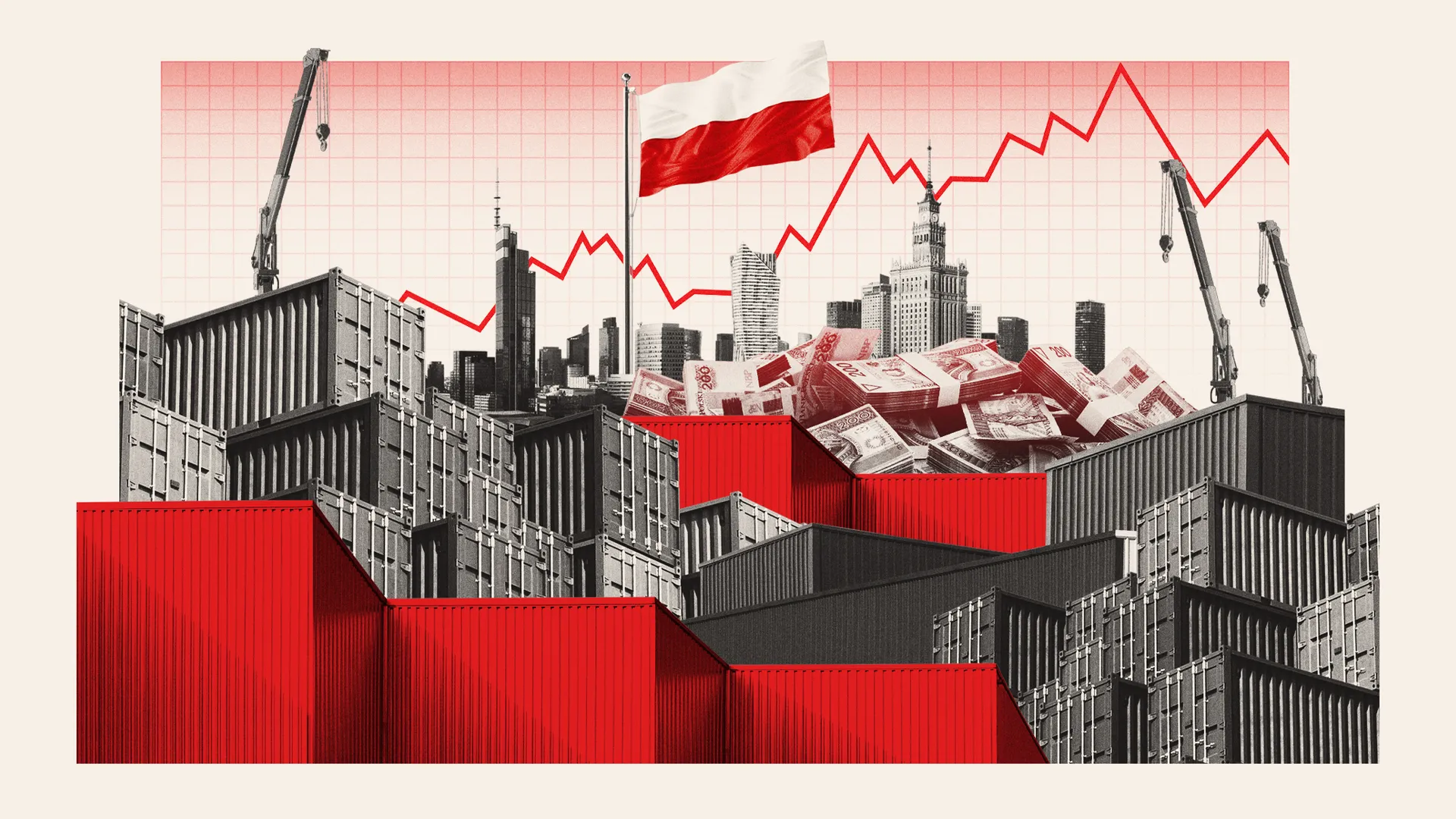
In the immediate aftermath of Poland’s Communist collapse, the country was considered one of the most economically dire in Europe — but the status quo has changed in a major way. Poland now has the 20th largest economy in the world, the country’s statistics agency announced last week, marking its highest-ever global ranking. Experts say there are a variety of factors that led to Poland becoming Europe’s new economic gem.
Poland entered the top 20 economies by leapfrogging Switzerland; it reported more than $1 trillion in economic output for 2025, with its gross domestic product increasing 3.6% year-over-year, according to Poland’s statistics agency. This is a far cry from the early to mid-1990s, when Poland “rationed sugar and flour while its citizens were paid one-tenth what West Germans earned,” said The Associated Press.
But in “35 years — a little less than one person’s working lifetime — Poland’s per capita GDP rose to $55,340 in 2025, or 85% of the EU average,” said the AP. One of the most important factors in Poland’s economic growth was “rapidly building a strong institutional framework for business,” economist Marcin Piatkowski of Poland’s Kozminski University told the AP. This includes the creation of antimonopoly agencies and regulatory bodies, ensuring that Poland’s economy “wasn’t hijacked by corrupt practices and oligarchs, as happened elsewhere in the post-Communist world.”
The Week
Escape your echo chamber. Get the facts behind the news, plus analysis from multiple perspectives.
SUBSCRIBE & SAVE
Sign up for The Week's Free Newsletters
Join more than 350,000 subscribers and keep yourself informed with a selection of The Week’s most interesting, enlightening and entertaining stories - plus daily puzzles.
Join more than 350,000 subscribers and keep yourself informed with a selection of The Week’s most interesting, enlightening and entertaining stories - plus daily puzzles.
Latest Videos FromThe Week US
Poland was also given significant help from the European Union both “before and after it joined the bloc in 2004,” said the AP. Once Poland became an EU state, it got additional funding as a result of its membership that “helped modernize Polish industry and expand an increasingly digitalized services sector,” said The Wall Street Journal. Above all, Polish business leaders “do not feel intimidated or constrained by any lingering sense of inferiority,” Dominik Kopiński, a senior adviser at the Polish Economic Institute, told Deutsche Welle. They “take opportunities when they see them and, more importantly, they are trailblazing for other companies.”
What next?
Even as Poland enjoys economic prosperity, not everyone is convinced that it will last. The country has a low birth rate and an aging society, meaning that “fewer workers will be able to support retirees,” said the AP. Wages in Poland are “lower than the EU average,” and “while small and medium enterprises flourish, few have become global brands.”
The country “must also contend with rising public debt,” said the Journal. Poland’s budget deficit of 6.8% is “significantly higher than the 3% benchmark for EU member states.” If Poland wants to continue climbing the economic ladder, its government will “need to rein in spending and raise taxes in order to ease debts over the coming years.” But there is also some good news, as Poland’s private-sector debt “remains low by EU standards.”
There is also the possibility of Poland leaving the EU, which could create further economic turmoil; dubbed ‘Polexit,’ Polish Prime Minister Donald Tusk has accused “right-wing opposition parties of steering the country toward leaving the bloc,” said Politico. “Polexit is a real threat today!” Tusk said on X. If his country left the EU, it “would be a disaster for Poland. I will do everything I can to stop them.”