Sign up to get Today’s Best Articles in your inbox
Join 350,000+ subscribers and keep yourself informed with a selection of
The Week’s most interesting, enlightening and entertaining stories - plus daily puzzles.
You are now subscribed
Your newsletter sign-up was successful
Want to add more newsletters?
An account already exists for this email address, please log in.
How bone-broth drinking ‘phenomenon’ has ‘skyrocketed’
The wellness trend could hold millennia-old secrets for skin and gut health
Bone broth “has undergone the PR glow-up of a lifetime”, said Saskia Kemsley in The Standard. Celebrities including Gwyneth Paltrow, Halle Berry and Kylie Jenner have all jumped on board, extolling its rejuvenating benefits.
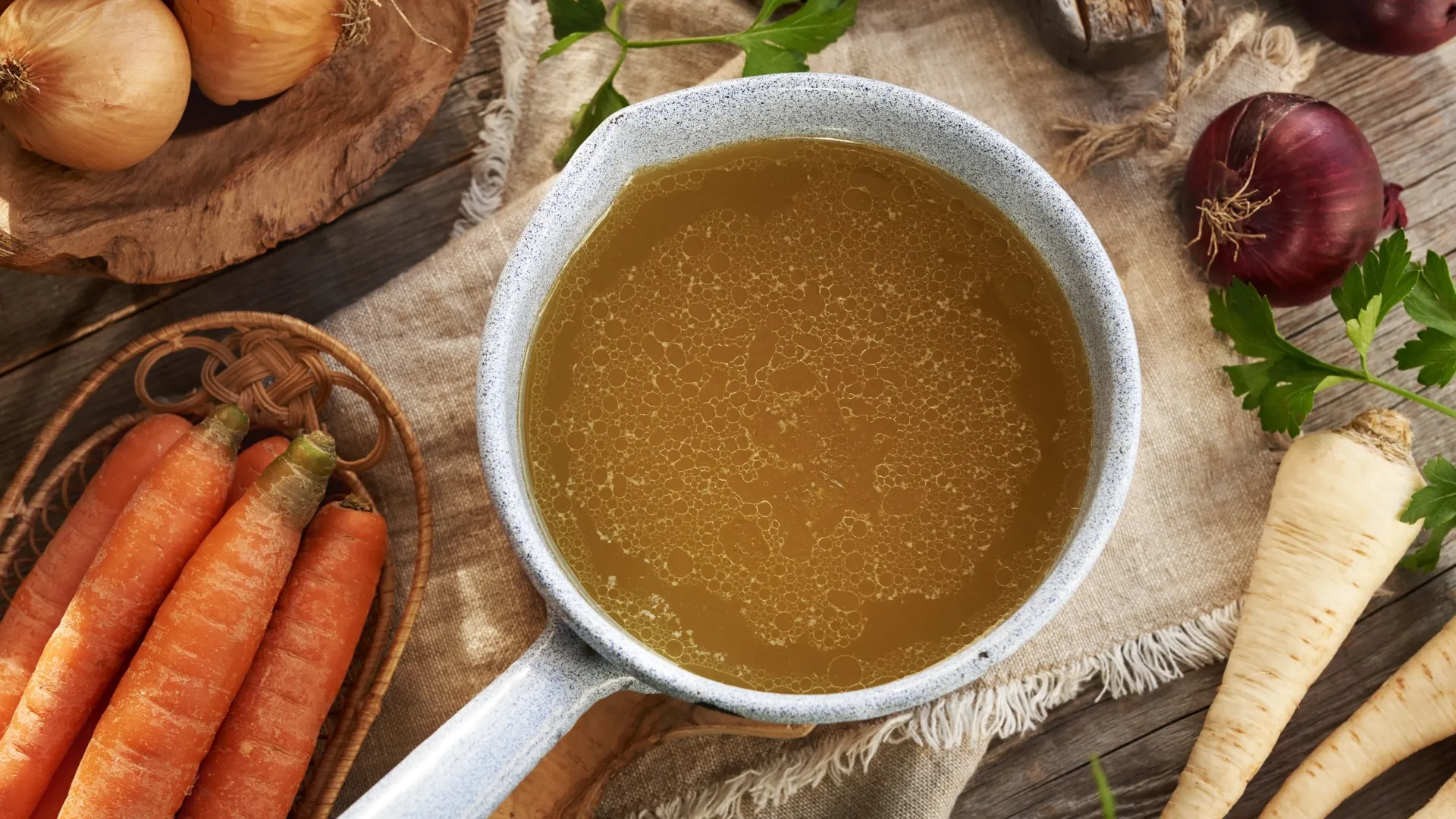
So what is bone broth? Put simply, it's a nutrient-dense liquid made by simmering animal bones with vegetables or other natural ingredients for up to 24 hours, similar to making stock for use in soups or stews. Drinking the broth for its health benefits is a “phenomenon” that has “skyrocketed” in recent years, even if the evidence is somewhat unclear.
“Of all the wellness trends, this one’s probably up there with the strangest,” said Daisy Jones in British Vogue. “A broth? Made from bones, you say? Sounds a bit fee-fi-fo-fum to me.”
The Week
Escape your echo chamber. Get the facts behind the news, plus analysis from multiple perspectives.
Join more than 350,000 subscribers and keep yourself informed with a selection of The Week’s most interesting, enlightening and entertaining stories - plus daily puzzles.
Join more than 350,000 subscribers and keep yourself informed with a selection of The Week’s most interesting, enlightening and entertaining stories - plus daily puzzles.
But bone broth promises an “array of supposed health benefits”. Some studies have shown that it is an anti-inflammatory “gut-healing powerhouse”, rich in electrolytes, and full of amino acids that help “regulate the immune system and promote gut health”. People are also indulging in a bid to improve their skin with the high collagen content. “Hmmm, maybe not so unappealing after all?”
Some of the most popular brands are “hugely expensive”, and often not much better than you can make at home, so you don’t need to “spend a fortune” buying the stuff, said Clare Finney in The Times. All you have to do is pop into a butcher’s for some “broken-down bones” at a “fraction of the price”, Michelin-star chef Emily Roux told the newspaper, “or if you’re making a roast chicken, never throw away the carcass”. After a four- to six-hour “long, slow simmer”, you can add combinations of “star anise, black peppercorns, any veggies or herbs that are suffering in the fridge” to “zhuzh it up”.
If you do want to splash out on a shop-bought broth, one of the best on the market is Borough Broth, whose organic beef bone broth is “filled to the brim with umami excellence” and has a “whopping 40% bone content”, said Kemsley in The Standard. Freja is another brand “taking supermarkets by storm for good reason”. Its broths have a two-year shelf-life, making them a “pantry essential”, and there’s also a fish-based version for pescatarians.
Despite the frenzied uptake by influencers who think it is a “wonder stew for your face”, some experts have a “bone to pick” with the trend, said GQ. Though it can be a great source of amino acids, the results can be inconsistent depending on what is cooked, and how.
Sign up to get Today’s Best Articles in your inbox
A free daily email with the day’s biggest news and analysis – and the best features from TheWeek.com
“My personal advice would be that it doesn’t add anything that a healthy diet containing a good source of proteinswouldn’t do”, Dr Christine Hall, NHS GP and aesthetics doctor, told the magazine. “In fact, a healthy, balanced diet will actually contribute more.”
Will Barker joined The Week team as a staff writer in 2025, covering UK and global news and politics. He previously worked at the Financial Times and The Sun, contributing to the arts and world news desks, respectively. Before that, he achieved a gold-standard NCTJ Diploma at News Associates in Twickenham, with specialisms in media law and data journalism. While studying for his diploma, he also wrote for the South West Londoner, and channelled his passion for sport by reporting for The Cricket Paper. As an undergraduate of Merton College, University of Oxford, Will read English and French, and he also has an M.Phil in literary translation from Trinity College Dublin.