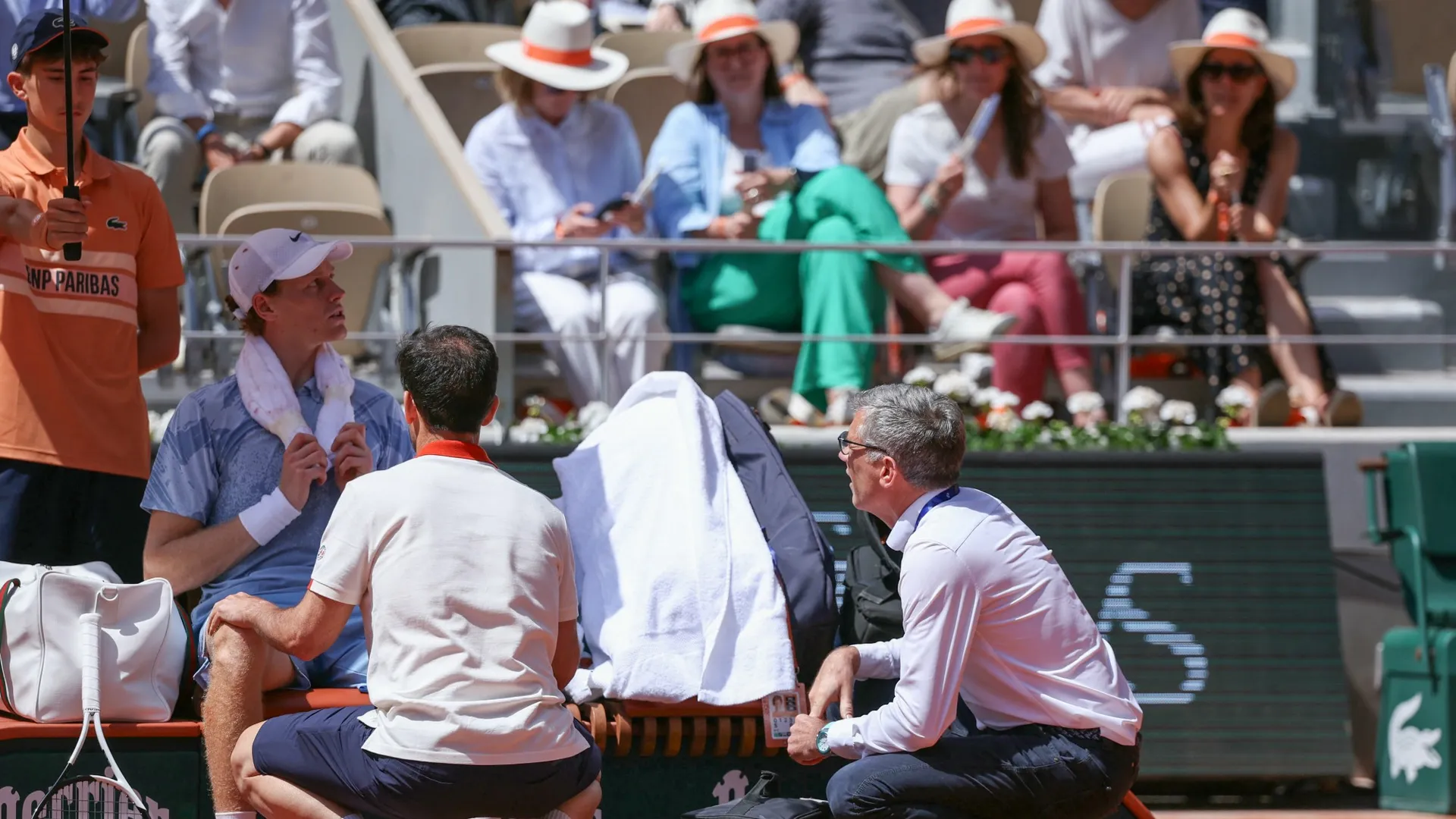
“It’s pretty worrying, the state of men’s tennis, especially right now,” said British star Jack Draper, announcing his withdrawal from Wimbledon this year due to injury. “The amount of injuries, especially young players.” Draper thinks “the tour and the calendar have to adapt if any of us are gonna achieve some sort of longevity”.
The unrelenting schedule of the ATP Tour has meant Draper’s world ranking has dropped from no. 4 to no. 147, and he faces the prospect of having to qualify for this year’s US Open, where he was a semi-finalist two years ago. He has missed most of the last year with the injury to his serving arm.
Players on both the men’s ATP and women’s WTA tours have long complained of the hectic playing schedule and called for reforms to ease the workload. But calendar alterations are just one of the many challenges players are facing.
The Week
Escape your echo chamber. Get the facts behind the news, plus analysis from multiple perspectives.
SUBSCRIBE & SAVE
Sign up for The Week's Free Newsletters
Join more than 350,000 subscribers and keep yourself informed with a selection of The Week’s most interesting, enlightening and entertaining stories - plus daily puzzles.
Join more than 350,000 subscribers and keep yourself informed with a selection of The Week’s most interesting, enlightening and entertaining stories - plus daily puzzles.
Latest Videos FromThe Week US
Injuries ‘steadily increasing’
“It is difficult to remember a time when each tournament’s build-up was not punctuated” with withdrawals like that of men’s world no. 1 Jannik Sinner from this week’s Cincinnati Open, said The Telegraph.
The calendar is to blame. Of the nine Masters 1000 events – one step below Grand Slams in prestige and usually lasting seven days – seven of them have “expanded to a 12-day format”. And punishments for opting out of the “gruelling” schedule don’t help players. Barring injury, they must play a minimum of eight such tournaments or “have their bonus pool reduced for each subsequent tournament missed”.
Optimists would argue that top players’ absences give opportunities to younger and lower-ranked players, but fans have started to “raise concerns” about their favourites “regularly missing events”. Clearly, the ATP Tour has “its own interests at heart”, attempting to “squeeze out every revenue source possible”.
This has impacted player health. “Survival of the fittest has become an apt metaphor for life on the tennis circuit in recent months,” said The Times. Injuries are “inevitable” in any sporting arena, but at the top level of tennis they are “steadily increasing”. University of Barcelona data from 2024 found that match retirements had increased by at least 25% and 50% on the ATP and WTA Tours respectively since 1999, while the Professional Tennis Players’ Association found that the average distance covered by players on court has increased “by more than 50 per cent since 2015”.
Players must contend with a “lack of recovery time and accumulated stress between matches”. In training, they can record performance “to the nth degree” with trackers and advanced technology, but these are banned in Grand Slam tournaments. However, “the stress of real competition is far greater”
Counterintuitively, players’ improved athleticism is also causing issues, said El Pais. In both men’s and women’s competitions, the physicality has “evolved exponentially compared with two or three decades ago”, meaning players can hit the ball harder, and have better equipment with which to do so. This places even greater strain when on the receiving end, and the rules are not adapting to accommodate this.
‘Highly vulnerable to match-fixing’
Environmental changes are also overlooked too, said the Financial Times. “Extreme heat is affecting tennis tournaments globally”, particularly at the French Open in May, and different organisations follow different rules to combat it. Until this year, the decision to suspend ATP matches due to weather conditions was “at the discretion of tournament supervisors”. Now a new “heat rule” is applied.
In addition to the playing schedule and more common heatwave conditions, tennis is “highly vulnerable to match-fixing”, said The Athletic. Top players may earn “more than $20 million in prize money each season”, but the majority of lower-ranked players “live a hand-to-mouth existence” on tour. “Fixers thrive on this inconsistency.”
The scoring system means players “can be convinced to corrupt matches whilst still winning them”: they can throw the opening set, or a particular service game, before “returning to playing at their best”. In December, French player Quentin Folliot was “suspended for 20 years on fixing charges, while Chinese player Pang Renlong was “barred for 12 years for separate offences”.
Like in other sports, change in tennis “takes time”, said The Independent. But unlike in others, tennis essentially has “seven governing bodies”, with the ATP, WTA, World Tennis and the four historic Grand Slam events all claiming certain jurisdiction. “Getting everyone around the same table is challenging enough”, let alone them agreeing on reforms to the game.