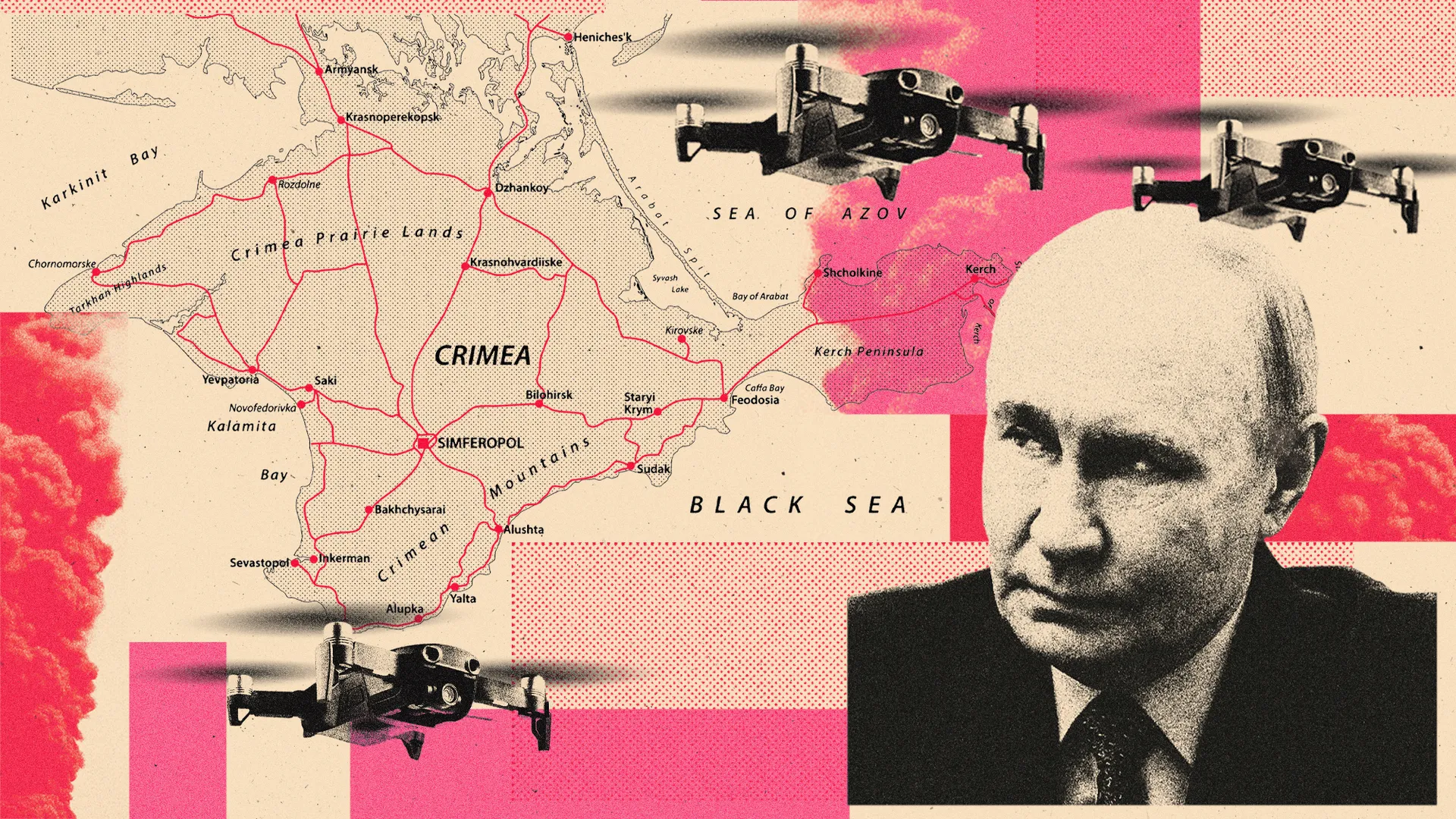
Vladimir Putin took the rare step of acknowledging fuel shortages in Crimea, following Ukrainian bombardments targeting the Russia-annexed peninsula. As Ukraine’s drones and missiles struck roads, railways and bridges, Putin admitted that there was only “a few days’ supply” left in Crimea, though he insisted that he was “confident” more fuel would be brought in soon.
The offensive has “upended life in Crimea and undercut its image as a showcase of Putin’s imperial ambitions” in Ukraine, said The Wall Street Journal. Although he “poured money into the peninsula”, locals say “basic services” like kindergartens, trash collection and ATMs have “stopped functioning”.
Ukraine’s offensive coincides with the approach of September’s Russian parliamentary elections, forcing the Kremlin to “maintain a strict sense of composure”, said The Wall Street Journal. Putin wants to prevent political tensions “from rising” over the situation in Crimea, framing Ukrainian strikes to his electorate as part of an information campaign to break Russia’s morale.
The Week
Escape your echo chamber. Get the facts behind the news, plus analysis from multiple perspectives.
SUBSCRIBE & SAVE
Sign up for The Week's Free Newsletters
Join more than 350,000 subscribers and keep yourself informed with a selection of The Week’s most interesting, enlightening and entertaining stories - plus daily puzzles.
Join more than 350,000 subscribers and keep yourself informed with a selection of The Week’s most interesting, enlightening and entertaining stories - plus daily puzzles.
Latest Videos FromThe Week US
“The unspoken assumption within the Ukrainian government is that it will have to accept Russia’s de facto control of Crimea as part of the price of peace,” said The Times. But the “outcome” may be “rather less predictable” than Volodymyr Zelenskyy “seems to think”.
Some “pragmatists” in Moscow feel that the war has “reached a point of diminishing returns” for the Kremlin, who should now “freeze the conflict” along current lines and “declare victory”. However, the “maximalist camp” calls for “escalation”, with the “mobilisation of hundreds of thousands of reservists”, the “deployment of conscripts” and “more aggressive covert operations” against the factories in Europe that are supplying Kyiv’s weapons.
It “may be a mistake” to conclude that these problems will “force the Kremlin to yield”, said Matthew Chance, CNN’s chief global affairs correspondent. Putin has “built a relatively brittle image as an uncompromising leader”, which makes “capitulation, retreat or even compromise in Ukraine incredibly unlikely and difficult for him to pull off”.
What next?
“Despite his macho public persona”, Putin is “generally quite risk averse”, but when he’s “panicked, he tends to make decisions hastily and badly”, said The Times.
In a worst-case scenario, “egged on” by hard-liners, a pressured Putin “does something particularly stupid, such as escalating attacks on Kyiv or even using tactical nuclear weapons”, said The Telegraph in a leader. The Russian foreign ministry has already alluded to the possibility of unspecified “systematic strikes”. When Nato leaders meet in Ankara next month, they “need to be ready for a potential showdown with Moscow”.