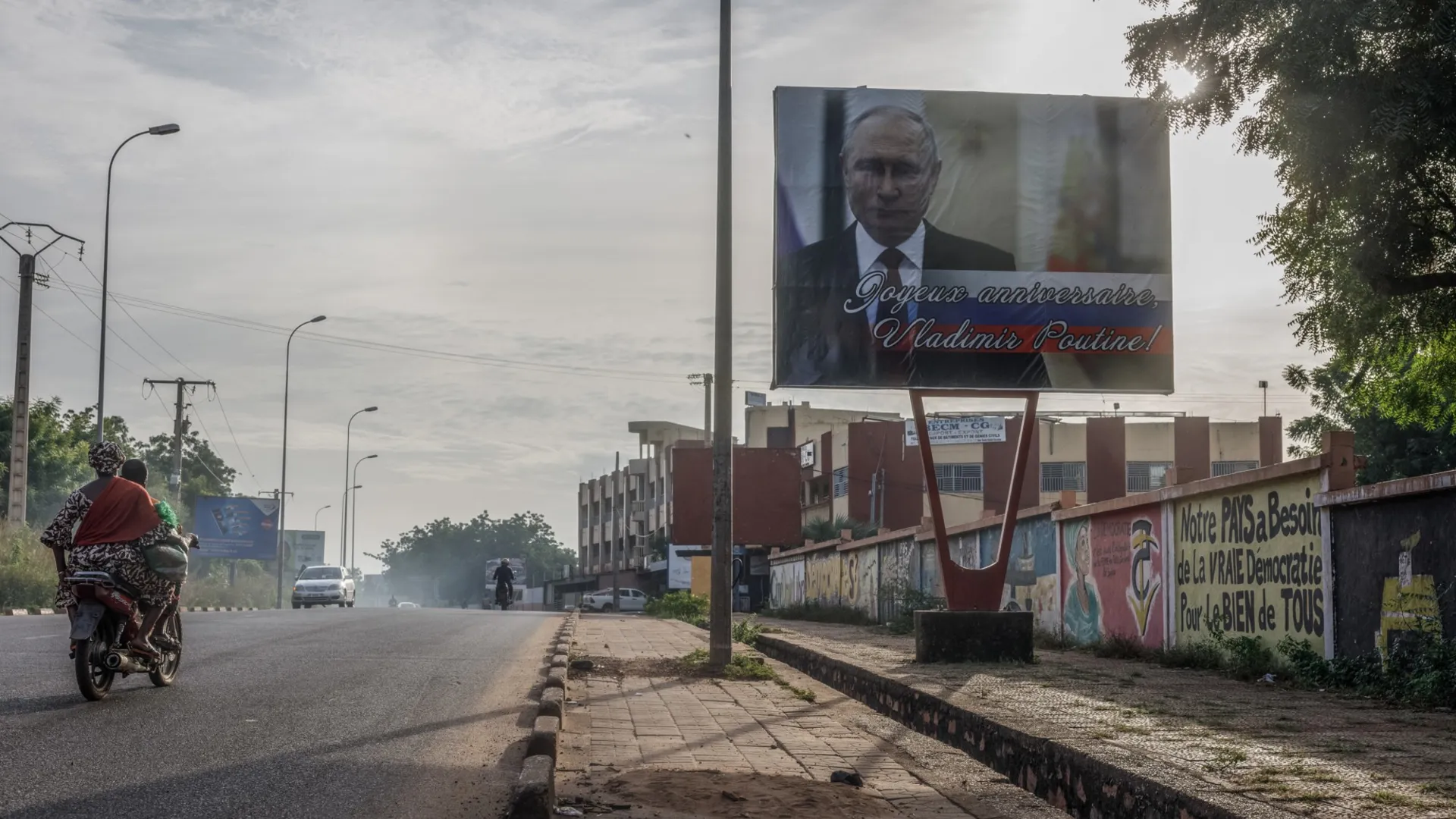
Russia’s Africa Corps is reeling after an alliance of separatist and jihadist groups in Mali launched a series of attacks on the country’s Putin-backed junta government in late April. Is this merely an instance of renewed violence in a country that has seen multiple coups this century? Or does the bruising rebuke to a feared Russian expeditionary force mark a potential crisis for one of West Africa’s most powerful and demanding benefactors?
‘Limits of Moscow’s reach and military might’
The “series of reversals” experienced by Mali’s “Moscow-backed military government” has “dented Russia’s image as a self-styled security guarantor in Africa,” said Reuters. The recent violence also “threatens” Moscow’s “strategic and economic interests on the continent.”
The attacks across Mali by “al Qaeda-linked rebels and mostly-Muslim Tuareg tribesmen” mark a “turning point in Moscow’s influence in West Africa,” said Fox News. Russia has been “grabbing Mali’s precious minerals, including gold,” while promising to “protect the country against the rebels.” The “wave of coordinated, surprise attacks” by Malian rebels has “exposed the limits of Moscow’s reach and military might in the impoverished West African state,” said The Guardian.
The Week
Escape your echo chamber. Get the facts behind the news, plus analysis from multiple perspectives.
SUBSCRIBE & SAVE
Sign up for The Week's Free Newsletters
Join more than 350,000 subscribers and keep yourself informed with a selection of The Week’s most interesting, enlightening and entertaining stories - plus daily puzzles.
Join more than 350,000 subscribers and keep yourself informed with a selection of The Week’s most interesting, enlightening and entertaining stories - plus daily puzzles.
Latest Videos FromThe Week US
In recent years, Mali had “drastically pivoted toward Russia” as the junta pushed out Western governmental support, said The New York Times. Russia has dispatched “thousands” of fighters from its Africa Corps, the military intelligence-run force born from the infamous mercenary Wagner Group that “provides security support to several African governments” in exchange for payment or “lucrative contracts for access to resources.” Mali is part of a chain of African nations, including Burkina Faso and Niger, that Moscow has “worked hard to cultivate” for both “geopolitical clout and access to mineral wealth,” said Irina Filatova, an honorary research associate at the University of Cape Town, to Reuters.
Withdrawing from Malian sites during the recent attacks “punctures the claim that Moscow could deliver where France and other Western allies could not,” particularly in the town of Kidal, which had “come to symbolize Russia’s promise” of stability, said Bloomberg. By “negotiating themselves out of Kidal” and “leaving their Malian counterparts behind,” Russia “doesn’t give a good impression of them as security partners,” Nina Wilén, the director of the Africa Programme at the Egmont Royal Institute for International Relations, said to the outlet.
Insurgents participating in the past week’s attacks were not expecting to “seize and control cities,” said a “security source” to La Agence France-Presse, per France 24. The goal instead was to “carry out coordinated actions in order to at least capture Kidal, which is a rather powerful symbol.”
‘Reputational damage’
The Africa Corps has “really lost credibility” in the region, said Ulf Laessing, the West Africa program lead at the Konrad-Adenauer Stiftung think tank, to Al Jazeera. Putin’s forces will “struggle to attract new clients” because they “just didn’t do their job — it’s reputational damage, what has happened.”
Russia’s potential “collapse” in Mali “threatens the region” but it also presents Washington an “opportunity to reassert the control it had foolishly relinquished,” said Hudson Institute Fellow Zineb Riboua at The Washington Post. African nations once tight with Moscow “have seen what Russian reliability looks like.” As those bonds are increasingly called into question, the U.S. should “seek to make that reversal permanent.”