Sign up to get Today’s Best Articles in your inbox
Join 350,000+ subscribers and keep yourself informed with a selection of
The Week’s most interesting, enlightening and entertaining stories - plus daily puzzles.
You are now subscribed
Your newsletter sign-up was successful
Want to add more newsletters?
An account already exists for this email address, please log in.
The best places to celebrate summer solstice
Salute the longest day of the year at Stonehenge – or these other remarkable solstice spots
From sunrise gatherings to dance festivals and floating-flower rituals, summer solstice celebrations certainly blow the cobwebs away.
The longest day of the year – when the sun reaches its highest point in the sky – has been marked all around the world for thousands of years, with traditions, holidays and festivals. For the northern hemisphere, the summer solstice usually comes on 21 June, while, for the southern hemisphere, it’s six months later, on 21 December.
This year in the UK, summer solstice sunrise – the start of celebrations for many – will be at 4.52am on 21 June, and the astronomical solstice – the exact moment that Earth’s axis tilts “towards the sun at its most extreme angle” – will be at 9.24am, said Space.com.
The Week
Escape your echo chamber. Get the facts behind the news, plus analysis from multiple perspectives.
Join more than 350,000 subscribers and keep yourself informed with a selection of The Week’s most interesting, enlightening and entertaining stories - plus daily puzzles.
Join more than 350,000 subscribers and keep yourself informed with a selection of The Week’s most interesting, enlightening and entertaining stories - plus daily puzzles.
The term solstice comes from “combining the Latin words sol, for ‘sun’, and sistere, for ‘to stand still’”, meteorologist Joe Rao told the astronomy site. Here are some of the best places to stand still yourself – or maybe join the chanting and drumming – to mark midsummer.
Stonehenge and around the UK
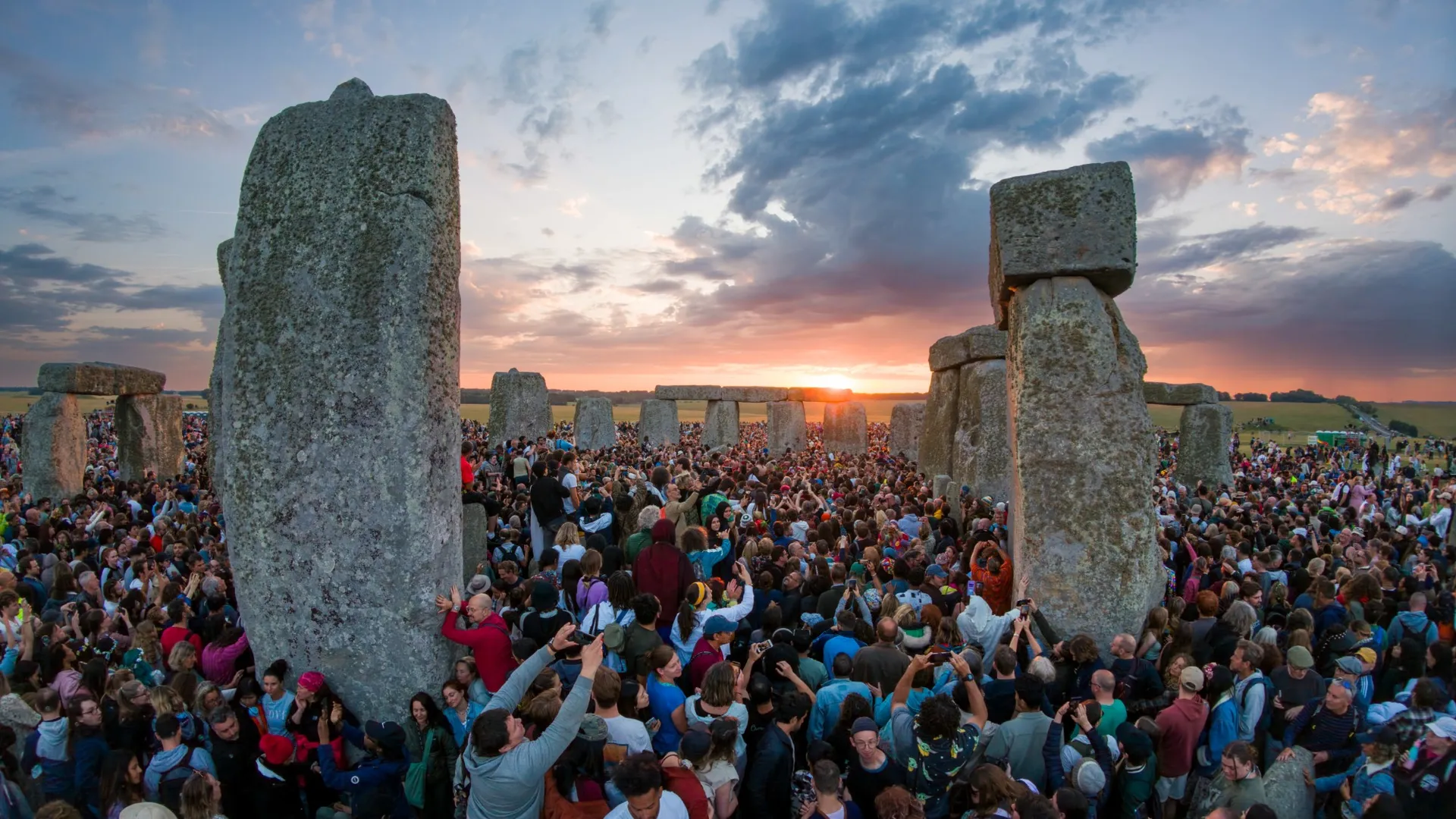
The 4,000-year-old stone circle in Wiltshire is one of the most famous places to observe the solstice. Visitors flock to the site near “to witness the moment the sun rises up behind the ‘heel stone’, the ancient entrance to the monument”, said the BBC. If you’re thinking of going there this year, note that parking is limited and must be pre-booked; there will be special shuttle buses from Salisbury train station.
Glastonbury Tor is the “second most obvious place in Britain to celebrate the summer solstice and, arguably, it has the better views”, said BBC Countryfile. “It’s one of Britain’s most spiritual sites, so you’ll be part of a crowd drumming and chanting as they have done here for millennia.” The Tor, “crowned by the ruins of 15th-century St Michael’s Church”, offers a “timeless” view of “some of Britain’s most beautiful hills”.
Further north, there’s Saltwick Bay – a “small yet particularly photogenic section” of the Yorkshire coast – where the sun rises (and sets) over the sea, and rock formations glisten with “mirror-like” pools in the early morning light. You can also watch the “Black Nab rock stack and the twisted wreck of the Admiral Von Trump take centre stage” as the sun rises higher.
Sign up to get Today’s Best Articles in your inbox
A free daily email with the day’s biggest news and analysis – and the best features from TheWeek.com
In Scotland, Arthur’s Seat, a “surprisingly wild spot” overlooking Edinburgh, is a “popular” and “lively” solstice viewpoint.
Europe and North America
In Greece, many “still follow the 2,500-year-old tradition” of climbing Mount Olympus to observe the solstice, while in some Eastern European countries like Belarus, people take “chaplets” – small flower garlands – to rivers and set them floating downstream, said Condé Nast Traveller. Swedes dance around “flower-covered maypoles”, and Catalonians “dress up as mystical or religious characters with typical ‘big head’ masks in a celebration that dates back to the Middle Ages”.
The Ottawa summer solstice Indigenous festival in Canada “puts First Nations culture on centre stage” with live performances, celebrating both midsummer and National Indigenous Peoples Day together.
And in Mexico, all eyes turn to the El Castillo pyramid at Chichen Itza, which was constructed so that the shadows of the setting sun at the summer solstice “look like a feathered serpent descending”. The symbol of Kulkulcan, a Mayan deity of wind, rain and the passing of time, it is a reminder “that the arrival of summer is a pivotal time to accept new beginnings”.
Will Barker joined The Week team as a staff writer in 2025, covering UK and global news and politics. He previously worked at the Financial Times and The Sun, contributing to the arts and world news desks, respectively. Before that, he achieved a gold-standard NCTJ Diploma at News Associates in Twickenham, with specialisms in media law and data journalism. While studying for his diploma, he also wrote for the South West Londoner, and channelled his passion for sport by reporting for The Cricket Paper. As an undergraduate of Merton College, University of Oxford, Will read English and French, and he also has an M.Phil in literary translation from Trinity College Dublin.