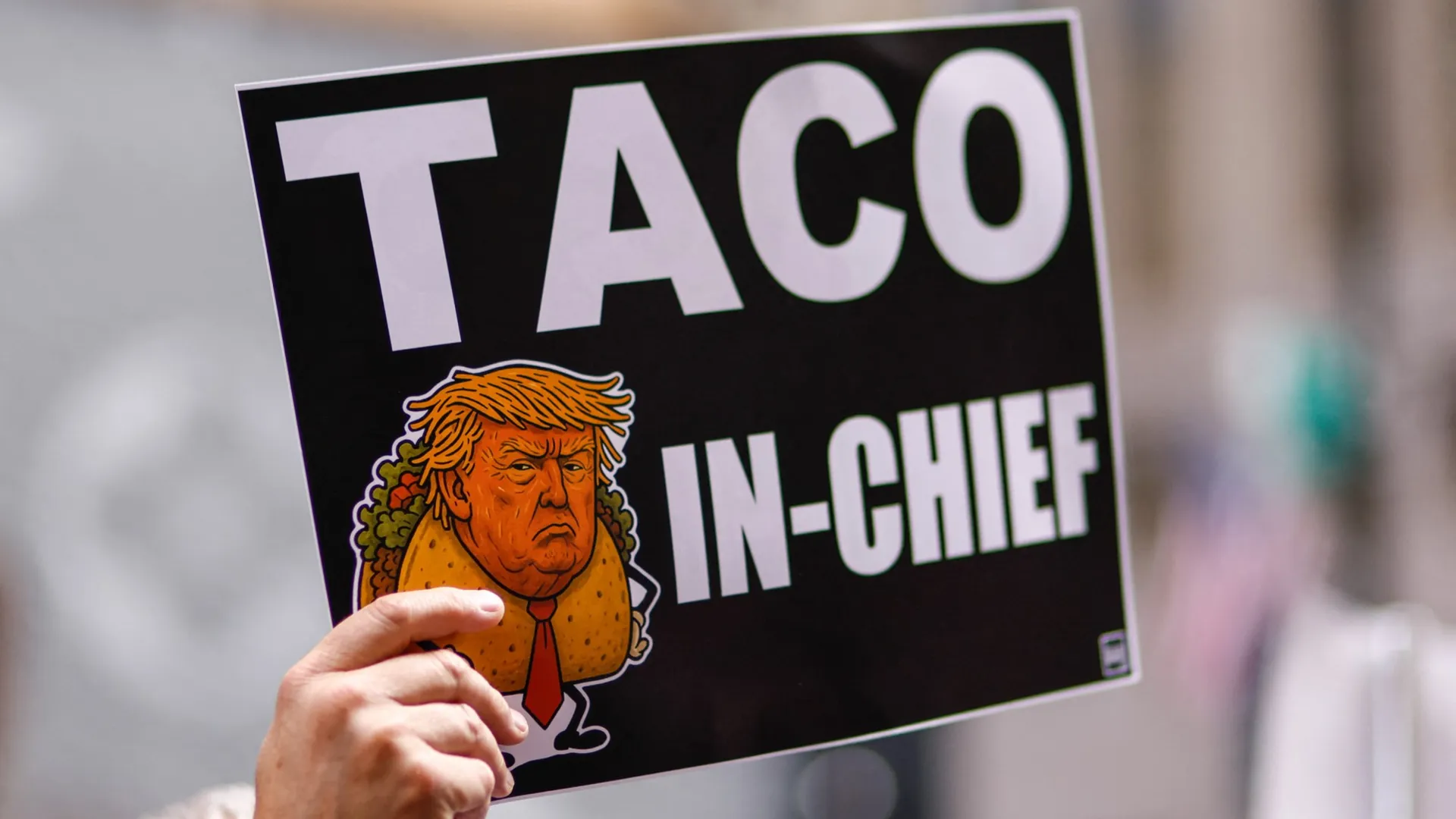
It isn’t often we can trace a widely used turn of phrase to a single, inspired genesis. Not so with the mocking ‘TACO’ appellation. Coined in May 2025 by Financial Times columnist Robert Armstrong, the acronym highlights President Donald Trump’s inclination to “Always Chicken Out” on his threats and proclamations.
While there have been numerous iterations and adaptations of Armstrong’s broader point (“perhaps the best Mexican food acronym for Trump is TAMALES,” said Reuters: “Trump Always Messes Around, Leaves Everybody Shafted”), none have quite captured the public’s imagination like Armstrong’s four-letter initialism. One year since its coinage, here are some of the president’s biggest TACO moments to date.
‘Liberation Day’ tariffs
The effects of Trump’s 2025 attempt to “remake the global trading system” by “erecting the largest tariff wall around the U.S. economy” in a century are “well-documented,” said Bloomberg. “Markets crumbled and then recovered when Trump delayed and scaled back his original duties” multiple times in the ensuing weeks, meaning that for a “certain audience,” a TACO “isn’t just a meal anymore.”
The Week
Escape your echo chamber. Get the facts behind the news, plus analysis from multiple perspectives.
SUBSCRIBE & SAVE
Sign up for The Week's Free Newsletters
Join more than 350,000 subscribers and keep yourself informed with a selection of The Week’s most interesting, enlightening and entertaining stories - plus daily puzzles.
Join more than 350,000 subscribers and keep yourself informed with a selection of The Week’s most interesting, enlightening and entertaining stories - plus daily puzzles.
Latest Videos FromThe Week US
Ultimately, the administration “threatened far more tariffs” than Trump has “carried through on,” said NBC. Trump’s trade strategy since his Liberation Day rollout of global tariffs has been “rushed and improvisational,” said the Council on Foreign Relations. Absent congressional input and lacking overall cohesion, the White House’s tariffs and subsequent policy are “not U.S. trade agreements but rather Trump’s trade deals” for better or worse.
Wall Street’s TACO trades
Trump’s Liberation Day rollout of worldwide tariffs “didn’t just reshape global trade,” said CNBC, it also “spawned a new play in the stock market: the ‘TACO trade.’” Here, the president’s “extreme position on policy” is inevitably replaced with a “more palatable place for equities, leading investors to then ‘buy the dip.’” Those who buy stocks “at lower costs after Trump announces new tariffs or increases them” later “reap the benefits when the markets rebound as he delays or backs off of them,” said ABC. “Oh, I chicken out? Isn’t that nice? I've never heard that,” said Trump when asked a “nasty question” in the Oval Office about his eponymous trading trend.
Immigration raids at farms and hotels
“Changes are coming!” Trump said in a June 2025 post on Truth Social that acknowledged “our very aggressive policy on immigration is taking very good, longtime workers away” from the agricultural, hospitality and leisure industries. The waffling commitment to his mass deportation raids was an “echo of Trump’s back-and-forth rhetoric on tariffs,” said the Detroit Free Press.
It was a “rare concession” from Trump that his policies were “hurting American farmers and hospitality businesses,” said The New York Times — “industries and constituencies that he does not want to lose.” The message from Trump’s shifting deportation tactics is “clear,” said The Daily Beast. The president’s “commitment to his own anti-immigration agenda cannot withstand pressure from his supporters” to protect “their bottom line.”
Threatening to end Iranian ‘civilization’
In “one of the more bizarre days in U.S. diplomatic history,” said The Washington Post, Trump’s threat to Iran back in April that a “whole civilization will die tonight” ended with the president “proclaiming a two-week ceasefire” to the U.S.-led war. Trump also announced the start of negotiations based on Tehran’s “10-point proposal,” which was full of “conditions that should be utterly unacceptable to any U.S. administration.”
Similar to the Paris Peace Accords that ended the Vietnam War, Trump can now “pretend that his bloodcurdling threats coerced Iran into giving up,” when he has “so far given up more than the mullahs did,” said the Post. Critics “lampooned” the episode as “another TACO moment,” said CNN, in which Trump backed off his “maximalist” demands “in a way that erased his red lines and raised doubts about his credibility.”
‘Guardian’ fees for the Strait of Hormuz
Just one day after threatening on “Fox and Friends” to position the United States as the “guardian angel of the strait” of Hormuz — and then “get paid for guarding it, a lot of money” — Trump “abandoned his threat,” telling reporters the plan would be “replaced by trade deals with Gulf states,” with whom he had spent the past 24 hours talking, said the BBC. “It was TACO Tuesday in Washington” when Trump walked back his threat, said CNBC. “And Wall Street was all too happy to take a bite.”
In Minneapolis, a ‘soft TACO’ pivot?
The more Trump has pushed the limits of his power, the less locked into a binary TACO dynamic he seems, despite Armstrong’s initial framing. It “might be more helpful,” then, to “craft a more limited soft TACO theory instead,” said Vox. While Armstrong asserts Trump possesses a “low tolerance for political or economic pain,” the soft TACO idea posits that his tolerance “can sometimes be quite high — even if it isn’t unlimited.” Trump’s decision to scale back deportation operations in Minnesota after the shooting deaths of two protestors, for example, “shows he was not entirely captured by hardline advisers or ideology,” nor was he “so insulated” that he could “ignore such intense backlash.” However, said Vox, “it took months — and two deaths — to get him to back down.”