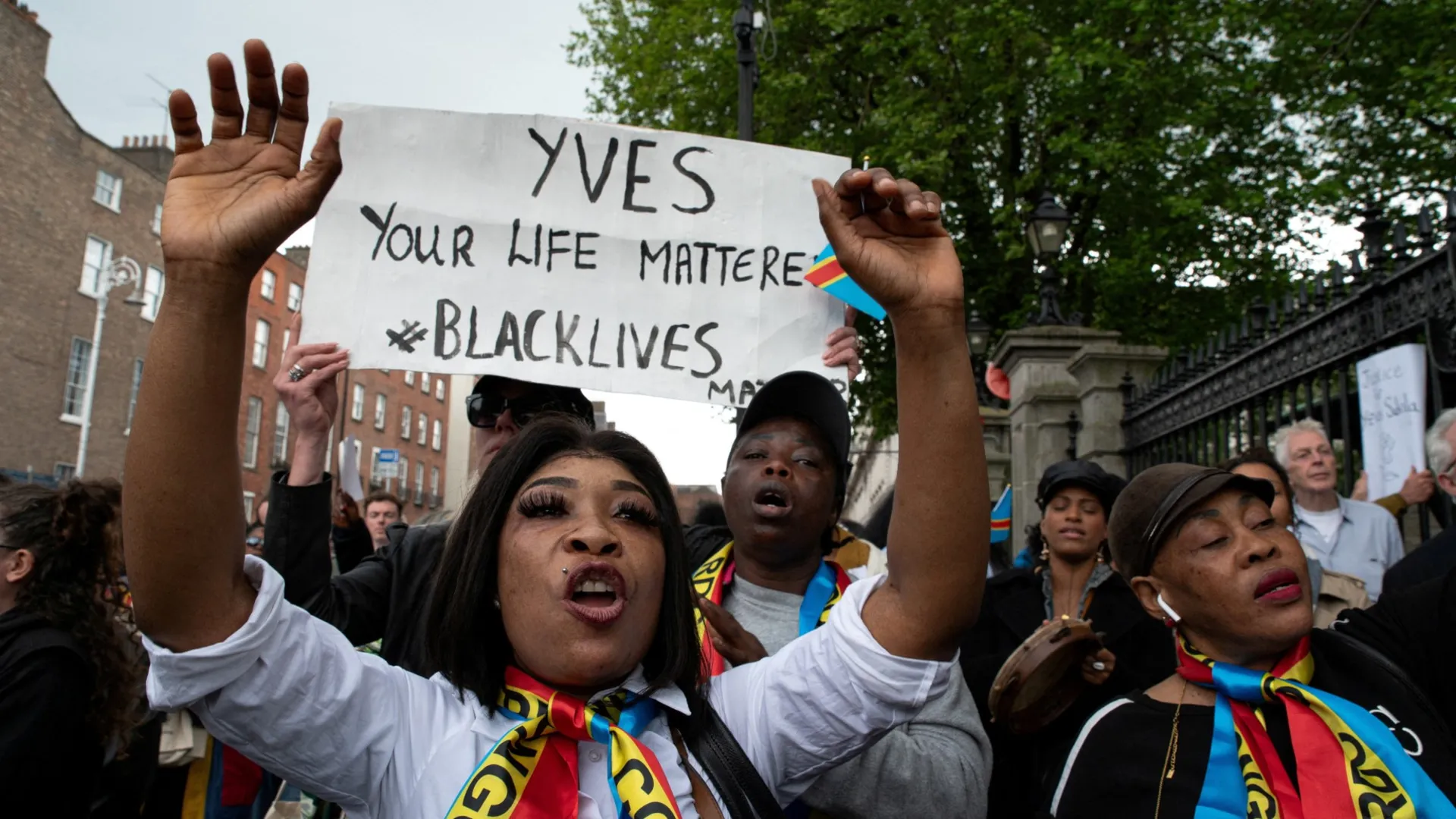
Nearly six years to the day after the death of George Floyd in Minneapolis sparked racial protests across the United States, something similar is happening across the pond. The death of a Congolese man in Dublin led people throughout the Irish capital to take to the streets, in what many are calling the country’s own George Floyd-like reckoning.
What happened?
The protests began over an incident on May 15, when Yves Sakila was detained by “several security guards who suspected him of shoplifting at Arnotts, Ireland’s oldest and largest department store, in the heart of Dublin” after he “allegedly stole a bottle of perfume,” said The Associated Press. Sakila, a 35-year-old native of the Democratic Republic of the Congo, was seen on video “struggling and crying out in distress as he was held down by several men for nearly five minutes.”
At least two of the guards “held his face to the ground and at one point one of them appeared to kneel on his head or neck for a few seconds,” said Reuters. Police eventually arrived on scene, and Sakila was taken to the hospital, where he was pronounced dead. Sakila’s death was seen by many as reminiscent of the murder of George Floyd, who died in 2020 “after being arrested by police outside a shop in Minnesota, prompting widespread protests under the Black Lives Matter banner,” said The Times.
The Week
Escape your echo chamber. Get the facts behind the news, plus analysis from multiple perspectives.
SUBSCRIBE & SAVE
Sign up for The Week's Free Newsletters
Join more than 350,000 subscribers and keep yourself informed with a selection of The Week’s most interesting, enlightening and entertaining stories - plus daily puzzles.
Join more than 350,000 subscribers and keep yourself informed with a selection of The Week’s most interesting, enlightening and entertaining stories - plus daily puzzles.
Latest Videos FromThe Week US
How has Ireland reacted?
The incident has caused anger and protests in Ireland, with many demonstrators calling for racial justice. Following Sakila’s death, at least “several hundred people attended a rally” in Dublin organized by Black Coalition Ireland, said The Irish Times. The protesters are demanding “proper transparent investigation into his death,” Black Coalition Ireland spokeswoman Cllr Yemi Adenuga told The Irish Times, as well as “racial training for all gardaí,” referring to Ireland’s national police force.
The protesters additionally called for an “end to the ‘demonizing rhetoric’ used by politicians or would-be politicians against ethnic communities and equal treatment for all communities, not just on paper but in practice,” said The Irish Times. The Democratic Republic of the Congo “remains steadfastly committed to establishing the full truth” of Sakila’s death, the country’s foreign affairs ministry said in a translated post on X. Irish government officials are also getting involved, with Ebun Joseph, Ireland’s Special Rapporteur on Racism and Racial Equality, calling for an investigation.
The footage of Sakila’s death has “caused profound distress, fear and outrage across many communities, particularly among Black and minority ethnic communities who already experience heightened anxiety regarding racial profiling, excessive force, unequal treatment and over-policing in public spaces,” Joseph said in a statement, per Irish broadcaster RTÉ. His death raises “urgent and serious questions which require comprehensive examination.” Irish Taoiseach Micheál Martin, the country’s prime minister, has also called for an investigation.
The incident will likely cause tensions to grow in a country that “continues to grapple with increasing political tension around immigration, following anti-immigrant protests and riots that erupted in Dublin in 2023,” said The Grio. Many are continuing to push for changes. “We call this a George Floyd moment,” David Kaliba, a former high school classmate of Sakila, said to Reuters. “I can’t believe it happened in America in 2020 and happened in Ireland in 2026.”