When you make a purchase using links on our site, The Week may earn a commission. All reviews are written independently by our editorial team.
Bring on the burning stoves and the hot-air blast of a roaring oven. Autumn’s new cookbooks are an inspiriting combination of history, practicality, design and, of course, endless attractive recipes.
‘Boucherie’ by Chase Cormier
One-time butcher, now a scholar, Chase Cormier is an ideal documentarian of the indispensable south Louisiana culinary tradition known as boucherie. The term, deep in the rural stretches of the Pelican State, can signify the art of butchering; it can also denote the raucous gatherings in which a pig — or pigs — is slaughtered and its parts processed and preserved for future sustenance.
The Week
Escape your echo chamber. Get the facts behind the news, plus analysis from multiple perspectives.
SUBSCRIBE & SAVE
Sign up for The Week's Free Newsletters
Join more than 350,000 subscribers and keep yourself informed with a selection of The Week’s most interesting, enlightening and entertaining stories - plus daily puzzles.
Join more than 350,000 subscribers and keep yourself informed with a selection of The Week’s most interesting, enlightening and entertaining stories - plus daily puzzles.
Latest Videos FromThe Week US
Cormier is “not sentimental,” said Kitchen Arts & Letters in an email review. Instead, he tells the story of how meat processing has changed over the centuries and how the idea of Cajun food has been “shaped, sold and reinvented.” Personal and regarded from a keen bird’s-eye view, “Boucherie” is a pocket-sized book that has a grand vision. (out now, $23, LSU Press, Amazon)
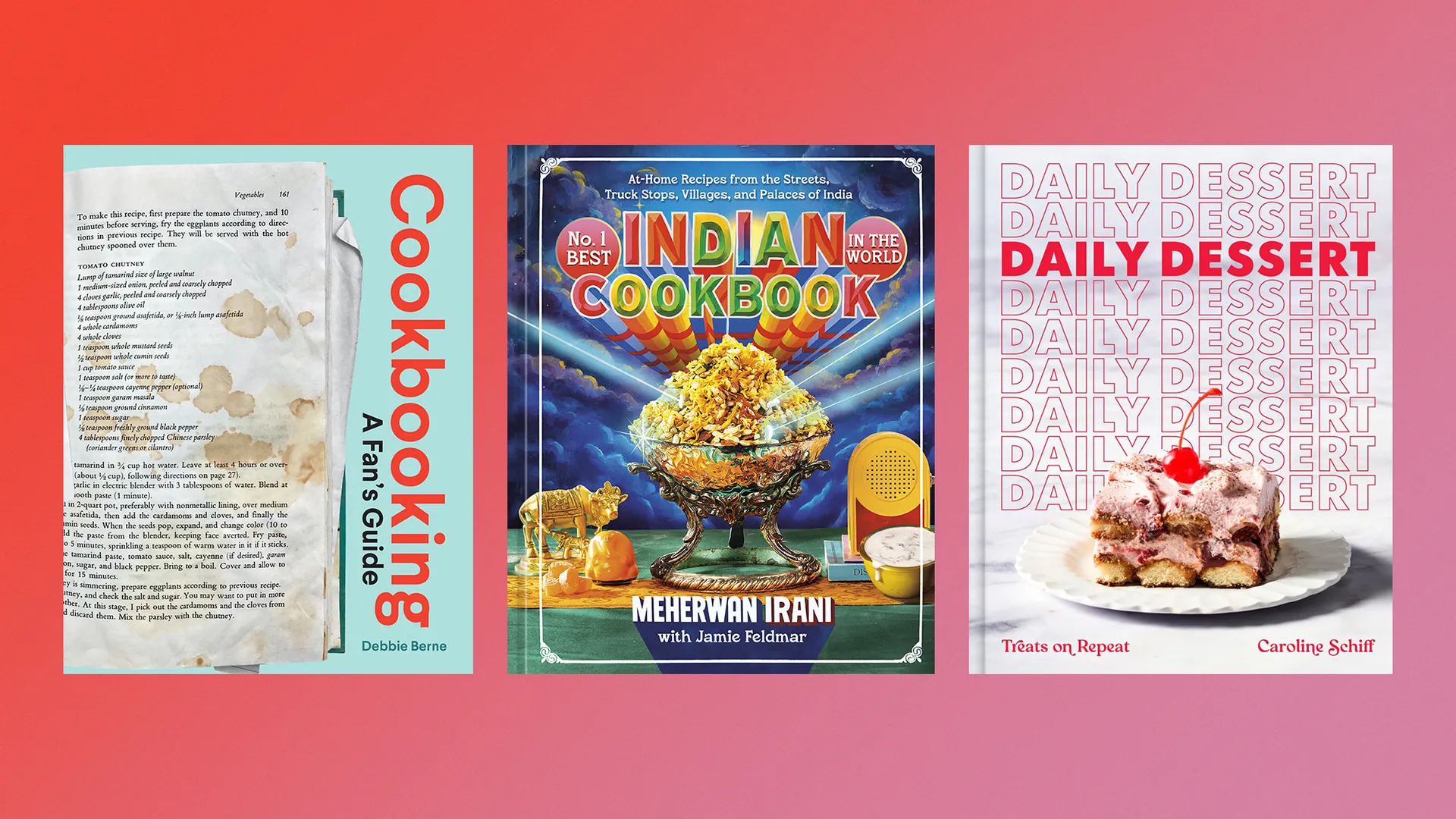
‘Cookbooking: A Fan’s Guide’ by Debbie Berne
Beauty is not strictly in a successful recipe but also in how the best cookbooks are presented. “Cookbooking,” by designer Debbie Berne who designed innumerable cookbooks and died last December, is a “savory tribute to cookbooks as aesthetic objects,” said Publisher’s Weekly.
The book’s range is astonishing. It touches on iconic tomes like “The Joy of Cooking,” dissects homespun community cookbooks often assembled by-hand and draws the thread from TV show-themed cookbooks to the current wash of food — and very much not-food — celebrity cookbooks. “Cookbooking” presents the finished product with a “lighthearted tone and loose structure,” a “colorful celebration” of a cookbook factor that the genre’s lovers sometimes take for granted. (out now, $30, Hardie Grant, Amazon)
‘Happy Snacking, Don’t Die!: Foraging and Vegan Recipes with Black Forager’ by Alexis Nikole Nelson with Jeanelle Hayner Olson
If you know the Black Forager on social media, you love her — or you should. Alexis Nikole Nelson, the freewheeling, insanely knowledgeable person beyond the handle, debuts her first cookbook, “Happy Snacking Don’t Die,” and as the title intimates, the book is a bounty of charming encouragement and cheeky asides. The “joy Nelson injects into the book makes foraging approachable,” said Emily Conover at ScienceNews.
You will learn that the fruits of the linden tree are akin to an earthier chocolate and that “practicality, safety and play” can coexist, said Bettina Makalintal at Eater. All this while you fumble your way into better trying understand and, yes, consume the plant world gloriously sprouting everywhere around you. (out now, $35, Simon & Schuster, Amazon)
‘Kincentricity: Connecting to Nature with American Indian Food Traditions’ by Enrique Salmón
Enrique Salmón, a Rarámuri (Tarahumara) scholar and professor in the San Francisco Bay Area, trumpets his book’s central tenet, “kincentricity,” as an “Indigenous worldview emphasizing the interconnectedness of all living beings and our responsibility to be good stewards of the planet we share,” said Jamie Feldmar at Saveur.
The book’s introduction, subtitled “Sharing Breath with Our Relatives,” takes the reader on a wander through the kincentricity’s complementary notion, iwigara, the “total interconnectedness and integration of all life in the Sierra Madre [Mountains], physical and spiritual.” You acquire, through Salmón’s clear sense of place, an ethnography of the people tied to this land and then glean, in the ensuing chapters on native foodstuffs like huckleberries, mesquite and stinging nettles, that no matter where you live, plucking the thread that links all life is a right and proper way to exist on this planet. (out now, $35, Rizzoli, Amazon)
‘No. 1 Best Indian Cookbook in the World’ by Meherwan Irani with Jamie Feldmar
Meherwan Irani, owner of a few Chai Pani restaurants in the southern United States along with the spice company Spicewalla, is one of a number of Indian American chefs who have noted the strong parallels between the cooking of the Indian subcontinent and that of the South. In Irani’s debut cookbook, “No. 1 Best Indian Cookbook in the World,” he drives the point home, with a “healthy mix of expected recipes and those likely new to most Americans, allowing readers to explore a wider variety of Indian cuisine,” said Aaron Pahl at Library Journal.
Collards, black-eyed peas and chiles are a few of the through lines between the cuisines. Irani sometimes rams them together in innovative ways. His Sloppy Jai is his adaptation of keema, a spiced ground meat dish, served like a Sloppy Joe as a thrilling, messy sandwich. Proof that “Indian cuisine is not only approachable, but that it’s not that different from what you’re already cooking and eating,” said Alana Al-Hatlani at Southern Living. (out now, $40, Ten Speed Press, Amazon)
‘Gather Around My Table: Simple, Flavorful Recipes from My Global Pantry’ by Kay Chun
Imagine, if you will, those translucent shrimp dumplings, har gow, you snag as a dim sum cart wheels past you. These, though, are dressed with butter and parmesan, like the liveliest comfort pasta you have ever eaten. Welcome to Kay Chun’s recipe-creating world, where you can use her book “Gather Around My Table” as your guide.
There is an effortlessness and an inevitability to how Chun creates dishes. She employs “low-lift but flavor-packed flourishes,” said Makalintal at Eater, to recipes like chicories in a caper-raisin vinaigrette and sticky date snacking cake with the addition of prunes for a double wallop of dried-fruit vigor. All the things you ever wanted to eat, in Chun’s capable hands, were there all along. (Oct. 6, $40, Knopf, Amazon)
‘Daily Dessert: Treats on Repeat’ by Caroline Schiff
Dessert-making need not always be like climbing Kilimanjaro. Sometimes it can be a stroll across a hillock, and celebrated New York City pastry chef Caroline Schiff has written a “book about making baking less annoying and more chill, a boon for anyone who would love baked goods more often but hates the thought of all the fuss,” said Makalintal at Eater.
One steady aspect of frippery-free baking is desserts that keep. Expect clementine snacking cake, granola treated with the flavors of halvah, malted milk chocolate truffles and rosemary-hazelnut shortbreads. A sweet treat should be both for now and later because, as Schiff wrote in the book’s introduction, “around the globe, dessert is, well, just that — daily. Many countries and cultures have joyfully and intentionally built the practice into their everyday lives,” Now it’s your turn. (Oct. 13, $35, Abrams, Amazon)
‘East to East: Recipes and Stories from Mumbai to New York’ by Rachel Gurjar
Forever toggling between the tastes of Mumbai and New York, the recipes of Gurjar, a former editor at Bon Appétit, are like skyscrapers: big-flavored with dependable foundations.
Burrata, served with pistachios and tamarind-glazed roasted grapes, yelps why it will forever be craveable. A chicken Caesar salad receives a deep plane facelift by treating the bird kebab-style. Yes, those are the invigorating spices of chai in that espresso martini and that taco bowl is loaded not with seasoning packet-laced ground beef but spunky lamb keema. The familiar has never been quite so promisingly electroshocked. (Oct. 13, $35, Chronicle Books, Amazon)