In 2024, before the US presidential election, young Africans were asked whether they expected their countries to fare better under Joe Biden or Donald Trump.
Across a range of measures, most respondents to the African Youth Survey believed Biden to be the better bet: 42-44%, compared with 23-24% choosing Trump. But in the most recent edition of the survey, nearly two-thirds of the near-5,000 18- to 24-year-old participants said they would benefit from the Trump administration, according to Foreign Policy. That’s despite the president’s foreign aid cuts, dismantling of development programs and “disparaging remarks about the continent”.
“This generation has worked out what much of the Western commentariat still refuses to,” said Ivor Ichikowitz, the survey’s founder. “Diplomacy is about what you can get from the man in the Oval Office, not whether you like him.”
The Week
Escape your echo chamber. Get the facts behind the news, plus analysis from multiple perspectives.
SUBSCRIBE & SAVE
Sign up for The Week's Free Newsletters
Join more than 350,000 subscribers and keep yourself informed with a selection of The Week’s most interesting, enlightening and entertaining stories - plus daily puzzles.
Join more than 350,000 subscribers and keep yourself informed with a selection of The Week’s most interesting, enlightening and entertaining stories - plus daily puzzles.
Latest Videos FromThe Week US
‘Strikes a chord’
Trump has never made a presidential visit to Africa. He has “seldom been polite about the continent”, said The Economist in 2018, “allegedly dismissing Nigerians as hut-dwellers and African states as ‘shitholes’”. Yet “he is more popular in Africa than in any other region”.
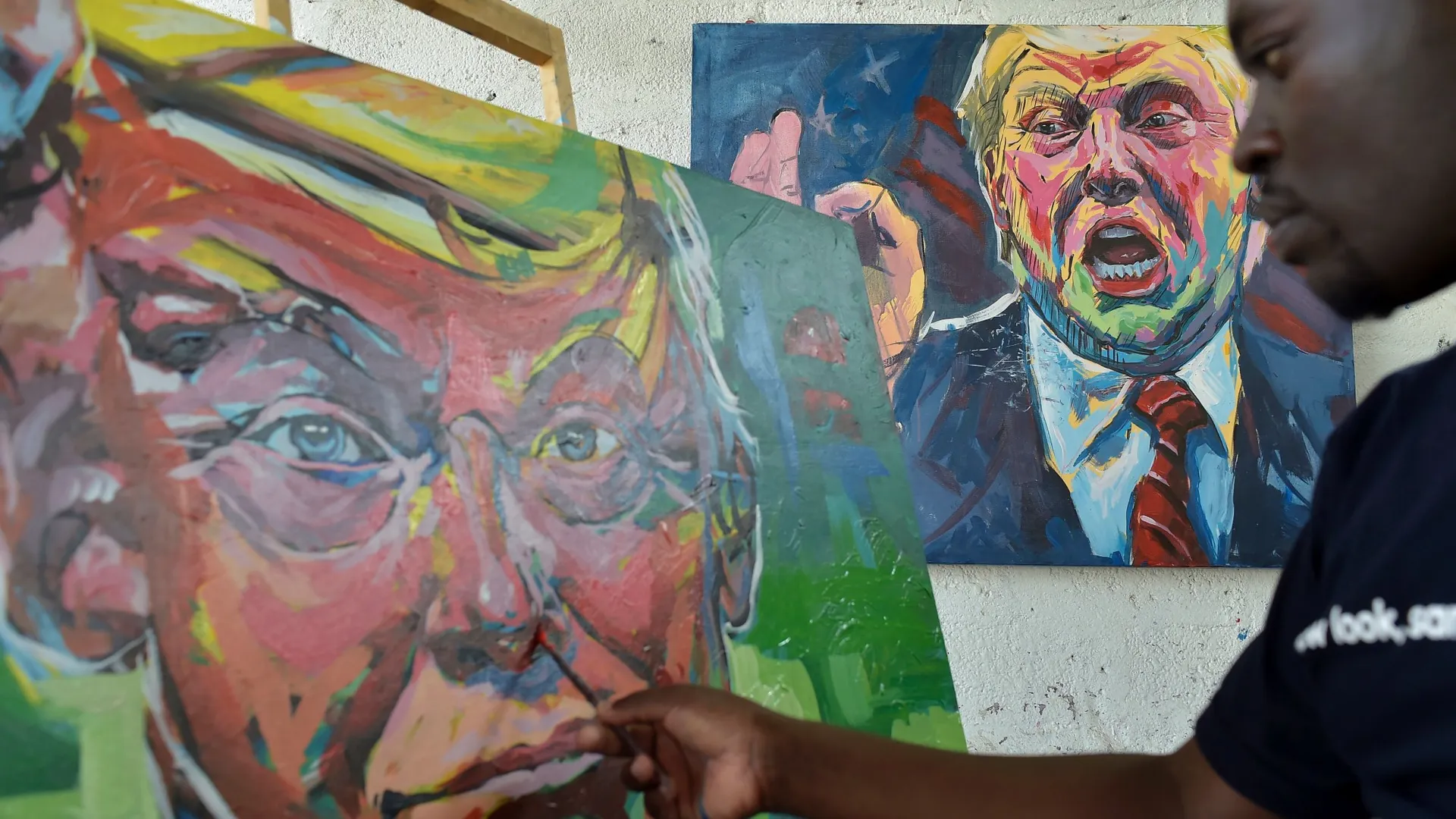
Even before Trump entered politics, there was a “large affinity towards him” in Nigeria, the most populous African nation, said The Guardian in 2020. His image as a “bombastic, straight-talking, self-made billionaire made his books a hit” in the country. Portraits of Trump, sometimes depicted in traditional clothing or in the military uniform of Nigerian dictators, are common. His image “strikes a chord”.
“Judging by our own president, it isn’t entirely surprising that a septuagenarian economic nationalist with a born-again vice-president, minimal respect for rule of law and archaic views about women is popular in Nigeria,” said Sa’eed Husaini, a political analyst in Lagos.
Nigerians have a “unique attachment to America”, wrote Africa expert Ebenezer Obadare on the Council on Foreign Relations. Whether in an “individualism that sometimes borders on outright sedition, or a risk-taking that often verges on self-immolation”, Nigerians see in the US an “admirable analogue of their own buccaneering spirit”.
Make Africa Great Again?
In 2025, 79% of Nigerians said they had confidence in Trump “to do the right thing regarding world affairs”, according to a Global Attitudes Survey by the Pew Research Center. That’s 21% higher than the same survey showed in 2017.
Many see Trump as the only president to defend Nigerian Christians; his administration claims they are being persecuted by Islamist groups.
The US went on to strike northern Nigeria, where Islamic State has a foothold, on Christmas Day in 2025, before beginning joint counterterrorism operations with the government this year. In the 2026 Global Attitudes Survey, confidence in him among Nigerian Christians had risen by six percentage points since 2025.
But more broadly, African Christians share commonality with American evangelicals and Trump, said the Council on Foreign Relations: a feeling of “being simultaneously persecuted by secular authority and pressured by a cultural momentum”, particularly with regard to sexuality and gender.
There is “overall African evangelical love for Trump”; he’s viewed as a “defender of family values” and a “symbol of masculinity in an age menaced by a rampant effeminacy”.
Trump’s business acumen is also admired among those who aspire to wealth, said Tendai Marima in Foreign Policy.
The so-called manosphere also has a strong influence in Africa, and Trump is seen as a “positive role model because of his values of manhood”. In South Africa, there is also strong support for Trump among the anti-migrant movement.
“As an African, what resonates with me most about the America First message is not that Africa should become America, but that African countries should also put their own citizens first,” said Freeman Bhengu, a member of anti-migrant group Operation Dudula.
In the Sahel, many see Trump as “ideologically close to their own military governments”, and their “nationalist-sovereign” rhetoric, said Lisa Tschörner, an international affairs researcher. Those countries perceive the US withdrawal of aid as “amounting to non-interference”.
According to the African Youth Survey, 26% of young Africans believe the US aid cuts could actually have a “positive impact”, despite experts’ concerns. As Ichikowitz said, some young Africans associate the withdrawal of aid with the “possibility of greater self-reliance and government accountability”.