Sign up to get Today’s Best Articles in your inbox
Join 350,000+ subscribers and keep yourself informed with a selection of
The Week’s most interesting, enlightening and entertaining stories - plus daily puzzles.
You are now subscribed
Your newsletter sign-up was successful
Want to add more newsletters?
An account already exists for this email address, please log in.
Donald Trump’s multibillion-dollar yen play
Framed as ‘good for the world economy’, joint intervention between US and Japan to boost the yen could mainly benefit America
“To Do. Buy Japanese Yen (JPY) $5-10 bil,” read a note written by US Treasury Secretary Scott Bessent during a cabinet meeting on Friday. By Monday, he had confirmed on X that the US had participated in “coordinated foreign exchange actions” with the Japanese government to counter “disorderly yen movements”.
In recent weeks, the yen sank to a 40-year low against the dollar, the latest milestone in Japan’s economic decline. However, having traded at ¥163 to the dollar on Thursday, the yen has strengthened to ¥155 to the dollar since the intervention.
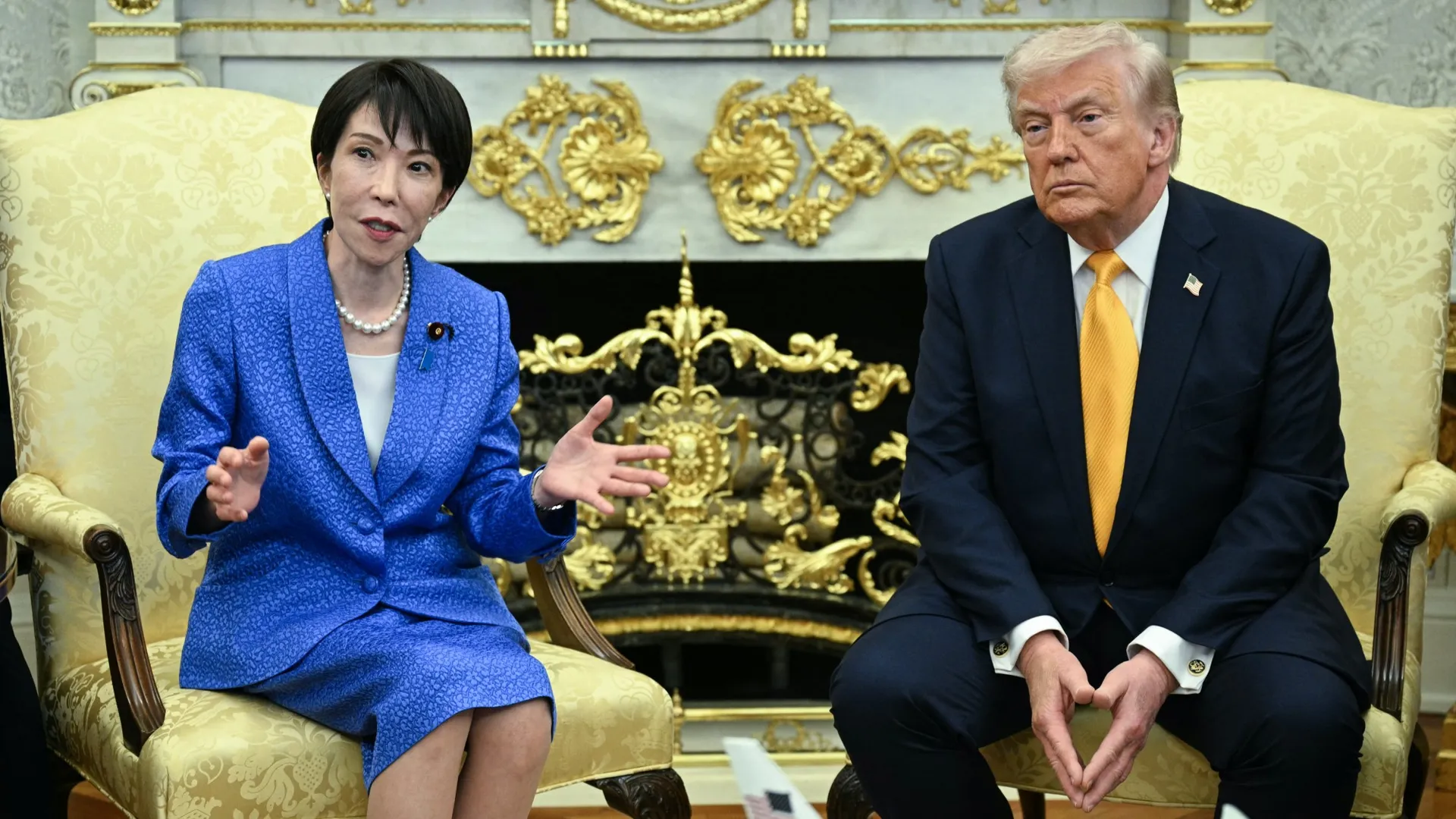
Donald Trump claimed the joint move would be “good for the world economy”. But some analysts believe the intervention will best serve America’s interests.
The Week
Escape your echo chamber. Get the facts behind the news, plus analysis from multiple perspectives.
Join more than 350,000 subscribers and keep yourself informed with a selection of The Week’s most interesting, enlightening and entertaining stories - plus daily puzzles.
Join more than 350,000 subscribers and keep yourself informed with a selection of The Week’s most interesting, enlightening and entertaining stories - plus daily puzzles.
Japan, the world’s fourth biggest economy, has “long struggled with a weak yen”, said CNN. After suffering recession and “chronic deflation” in the 1990s, Japan has kept interest rates much lower than other developed economies. In April, the Bank of Japan increased its rate to 1% – the highest since 1995 – while the US rate usually lies between 3.5% and 3.75%. While such low rates hope to stimulate consumer spending, they also are much less attractive to international investors.
Global events such as the Iran war have also impacted Japan’s import-heavy economy. The country is “resource-poor”, said The Japan Times, with around “95% of its oil imports” coming from the Middle East before the recent conflict began. While a weak yen is beneficial for Japan’s exporters and the tourism industry, energy and fuel inflation have hit the country’s population hard.
Other issues such as a “decades-long slide in its working-age population”, substantial government debt and low productivity have also hampered economic growth, said the BBC.
What’s in it for Trump?
The president called the move a “signal of friendship” between the two nations. The US is “always there for Japan”, a country that has been “very good to us, with the exception, of course, of Pearl Harbor”.
Sign up to get Today’s Best Articles in your inbox
A free daily email with the day’s biggest news and analysis – and the best features from TheWeek.com
But the US also stands to benefit. The Japanese government has been buying up yen, thereby “raising the value of their currency”, said The Guardian. But to pay for this, Japan has been selling off US government bonds, which are kept by many countries as a “store of national wealth”. If, however, these bonds are sold quickly and in large quantities, it can lead to a rise in the interest rate the US pays on its debt, thus making it more expensive for the US to borrow money.
Another factor behind the intervention could be that Trump sees Japan’s Prime Minister Sanae Takaichi as an “ideological ally”. In October, the US bought “billions of Argentinian pesos to help prop up the country’s finances” just weeks before midterm elections for President Javier Milei, another ally of Trump’s. Takaichi’s defence agenda – she is planning to double spending to 2% of GDP over the next five years – has been “broadly welcomed” by the Trump administration.
Is this a sign of things to come?
Both US Treasury Secretary Scott Bessent and Japanese Finance Minister Satsuki Katayama have announced they would not hesitate to participate in further joint interventions.
In April, the Bank of Japan took action to boost the yen, said CNN, but it proved to be only a “temporary success”. Analysts are “less optimistic” that this latest intervention could “fundamentally alter the broader course of the yen’s weakening”.
Within Japan, there is concern that Takaichi’s spending plans will put further pressure on the currency. A two-year cut in sales tax on food and soft drinks from 8% to 1% is an attempt to ease cost-of-living pressures, and the PM has promised to invest hundreds of billions as part of a pro-growth agenda that led to her election. However, the policies could instead “strain public finances and rattle markets”, said the Financial Times.
Will Barker joined The Week team as a staff writer in 2025, covering UK and global news and politics. He previously worked at the Financial Times and The Sun, contributing to the arts and world news desks, respectively. Before that, he achieved a gold-standard NCTJ Diploma at News Associates in Twickenham, with specialisms in media law and data journalism. While studying for his diploma, he also wrote for the South West Londoner, and channelled his passion for sport by reporting for The Cricket Paper. As an undergraduate of Merton College, University of Oxford, Will read English and French, and he also has an M.Phil in literary translation from Trinity College Dublin.